
what is the
$10 a day plan?

“$10 a day child care” has become the familiar catchphrase for Canada’s first Canada-wide child care policy, the Canada-Wide Early Learning and Child Care plan (CWELCC). But what is $10 a day child care?
The $10 a day child care plan is more than affordable parent fees
To many people, it means the highly visible reduction to $10 a day parent fees now in place in much of Canada. But the phrase is merely shorthand for a much more expansive long-term plan made up of interlinked parts. Affordable parent fees are but one piece of this plan – although a critically important piece.
What are the goals of the $10 a day child care plan?
The federal government’s overarching goal is “to ensure that all families have access to high-quality, affordable, and inclusive early learning and child care no matter where they live.” It is “a plan to drive economic growth, secure women’s place in the workforce, and give every Canadian child the same head start.” The government’s goals are consistent with those for which Canada’s child care movement has advocated for over 50 years.
Partnerships
The $10 a day child care plan operates through federal, provincial, and territorial partnerships based on agreed-upon high-level principles. These partnerships are formalized through bilateral agreements that enable federal funding transfers to each province and territory. Federal, provincial, and territorial money now funds the bulk of licensed child care costs.
The federal government has strengthened its commitment to the plan:
- Initially committing about $30 billion to launch the $10 a day plan in 2021
- Passing Canada’s first federal child care legislation in 2024
- Adding capital funding to the original 2021 funding package
- Extending the bilateral agreements and previous funding until 2031
- Adding an additional $5.4 billion to cover two years (2027 – 2029)
What’s included in the $10 a day plan?
The terms of the federal plan allow provinces/territories to include all licensed child care for 0–6 year olds: full-day child care centres, family child care, part-day preschools/nursery schools, and before- and after-school child care for children up to age six. There are some variations in how provinces and territories include these program types. The plan includes only provincially or territorially licensed programs.
Making systemic change
The first five years of the $10 a day plan have “focused on building the right foundations for a truly Canada-wide system of child care.” The foundation was to have included Critical components and elements identified by the federal government as:
- Significant reduction of fees for $10 a day for 0 – 5 year olds by 2026. As a result, child care service providers have been able to shift from mainly relying on parent fees to being largely publicly funded.
- Ongoing growth in high quality affordable child care by expanding (primarily) public and non-profit provision, addressing inequitable distribution of licensed child care by region, income, ethnicity/race, and other factors.
- Ensuring that families in all existing child care can benefit from fee reduction by publicly funding existing licensed non-profit, public, and for-profit spaces.
- Protecting the emerging child care system by expanding (primarily) public and non-profit provision.
- Ensuring inclusion and respecting diversity of all families and children in an equitable system.
- Valuing early childhood educators’ work to ensure they are at the heart of the system, addressing the low wages and poor working conditions that have always affected the 95% female child care workforce.
- Making meaningful progress improving and expanding before- and after-school child care.
- Building a strong baseline of common, publicly available data to ensure accountability, measure progress, report to Canadians, and improve the system.
- Addressing the needs of Indigenous families and communities as a critical part of Reconciliation.
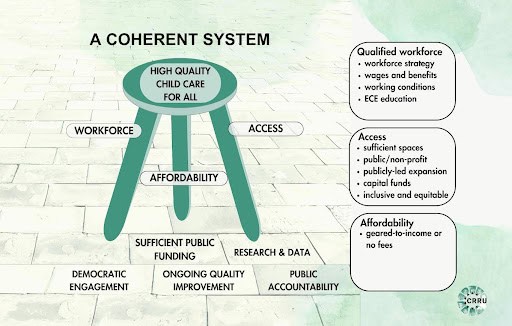
The whole of the $10 a day plan is greater than the sum of the parts
Experience in multiple countries and international research on child care systems shows that a coherent, integrated policy package of interlinked elements is much more effective than piecemeal approaches, as the three-legged stool graphic shows.
The $10 a day plan elements are elaborated in a 10-point roadmap to a quality system developed by child care advocates.